

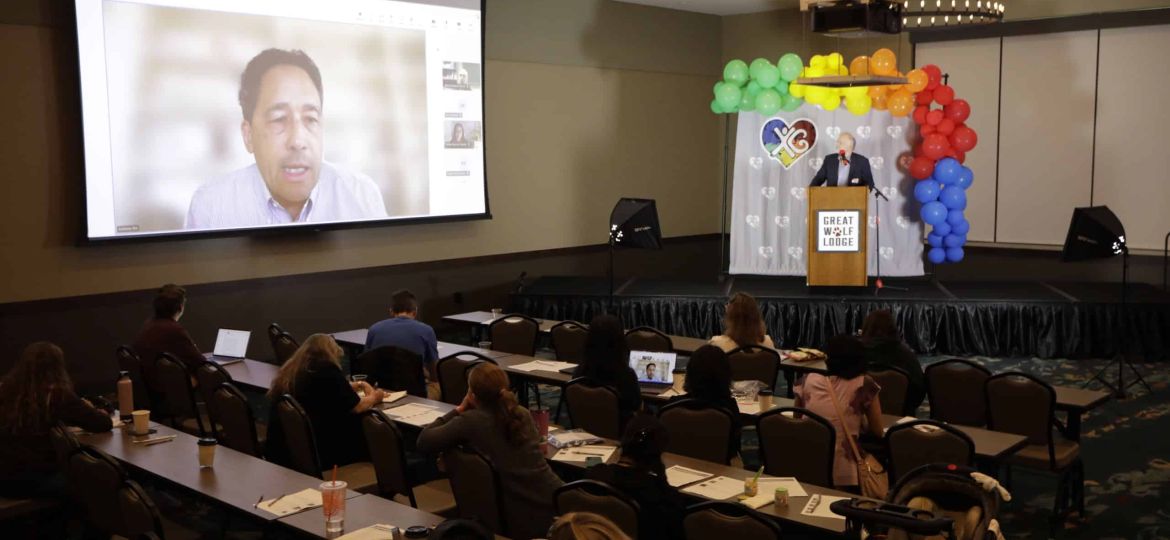
At our 2026 conference, seven researchers gave us a look at where XGS science stands right now, and where it’s headed. Board Director Melissa Milano has created a plain-language summary of each talk, with the full video linked so you can watch at your own pace.
You don’t need a science background to follow along. If a term is new to you, we’ve explained it as we go.
Dr. Gibbs: The State of Xia-Gibbs Syndrome Research
Dr. Gibbs led the conference with an exciting update of the state of Xia-Gibbs Syndrome research. With nearly 650 identified cases worldwide and 250 registry participants, awareness of Xia-Gibbs syndrome is growing rapidly and research is expanding internationally, with Brazil and Italy leading molecular studies to understand how the challenging AHDC1 protein functions, while Baylor focuses on DNA and genetic research to advance future therapies.
Dr. Pehlivan: Understanding Epilepsy in Xia-Gibbs Syndrome
Dr. Pehlivan shared information on epilepsy in Xia-Gibbs Syndrome, beginning with the definitions of seizures as sudden changes in brain function, and epilepsy as 2 or more unprovoked seizures. In Xia-Gibbs syndrome (XGS), seizures affect an estimated one-third to one-half of individuals, typically beginning around ages 5–6, and are diagnosed using EEGs. Because research on seizures in XGS is limited, there is no established best treatment, highlighting the need for larger studies to identify the most effective medications, better understand seizure risk by age and genetic mutation, and improve care for patients.
Watch Dr. Pehlivan’s full talk
Dr. Hu: A Multi-Omics Approach to XGS
Dr. Hu explained her team’s “multi-omnics” approach to XGS research, which studies multiple layers of biology at the same time—such as a person’s DNA, gene activity, proteins, and cellular processes—to better understand how AHDC1 mutations cause Xia-Gibbs syndrome. Using samples collected at the 2024 XGS Conference, researchers identified thousands of differences in gene activity and are developing new patient-derived stem cell (iPSC) models representing a wider range of AHDC1 mutations to better study brain, muscle, and neuromuscular development and support future therapeutic research.
Dr. Calame: Precision Therapy Approaches
Dr. Calame reviewed several “precision therapy” approaches for neurodevelopmental disorders, emphasizing that the best strategy depends on whether a genetic condition is caused by loss of function or gain of function. These approaches include antisense oligonucleotides (ASOs), which can reduce harmful gene activity or restore normal protein production, viral gene replacement to deliver working copies of missing genes, and newer gene-editing technologies that are designed to directly correct disease-causing genetic changes.
Dr. Oro: Building the First Cellular Model of XGS
Dr. Oro’s team is studying what the AHDC1 gene normally does during early human development and how changes in the gene lead to Xia-Gibbs syndrome (XGS). Because AHDC1 is not found in common research models like flies and worms, the team developed miniature human skin tissues from stem cells to study how body tissues communicate, finding that loss of the AHDC1 protein disrupts these signals and affects the development of multiple body systems—not just the brain. This work represents the first cellular model of XGS, providing an important new tool for understanding the condition and potentially testing future gene-editing therapies.
Dr. Sanges: AHDC1 as a Cellular Organizer
Dr. Sanges’ research suggests that the AHDC1 protein acts as an organizer inside cells, helping groups of proteins work together and controlling which genetic instructions are turned on or off at the right time during development. When AHDC1 is not functioning properly, this cellular organization breaks down, disrupting normal growth and development. These findings provide important clues about how changes in AHDC1 may lead to Xia-Gibbs syndrome and point to new directions for future research.
Maisa Sennes (Ph.D. Student): Connecting Genes to Real-World Features
Maisa Sennes and team’s research aims to understand how changes in the AHDC1 gene lead to the features seen in Xia-Gibbs syndrome by combining information from people with XGS, animal models, and human cell models. Her team is studying unique clinical patterns in individuals with XGS, using zebrafish models to observe how AHDC1 changes affect development, and creating patient-derived nerve cells from blood samples to study differences in structure and function. These approaches will help uncover the biological pathways involved in XGS and guide future research toward potential treatments.
Watch Maisa Sennes’s full talk
What This Means for Our Community
A few themes ran through the weekend.
Researchers are building laboratory models of Xia-Gibbs syndrome that didn’t exist before, stem cell models, skin tissue models, zebrafish, patient-derived nerve cells. For a condition that can’t be studied in the usual research organisms, having a way to study it in the lab at all is a real step forward.
The work is also global. Brazil, Italy, and the United States are all contributing, and the questions are getting more specific: not just what AHDC1 does, but how different mutations lead to different outcomes.
And the research depends on us. Dr. Pehlivan was explicit that larger studies are needed to answer basic questions about seizures. The stem cell models, the nerve cells, the clinical patterns, all of it starts with samples and information shared by families.
Three ways you can help right now
Join the patient registry. 250 participants have enrolled so far. Every additional enrollment sharpens what researchers can learn about seizure risk, developmental patterns, and how specific mutations behave. Join the registry
Share this recap. Xia-Gibbs syndrome is still under-diagnosed, and many families are searching for answers. Sharing this post helps them find us.
Support the work. The Xia-Gibbs Society funds research, brings this community together, and makes conferences like this one possible. Donate today
Thank you to every researcher who presented, and to every family who traveled to be with us. Videos of all seven talks are linked above. If you have questions about any of the research shared here, reach out to us, we’re glad to help connect you.